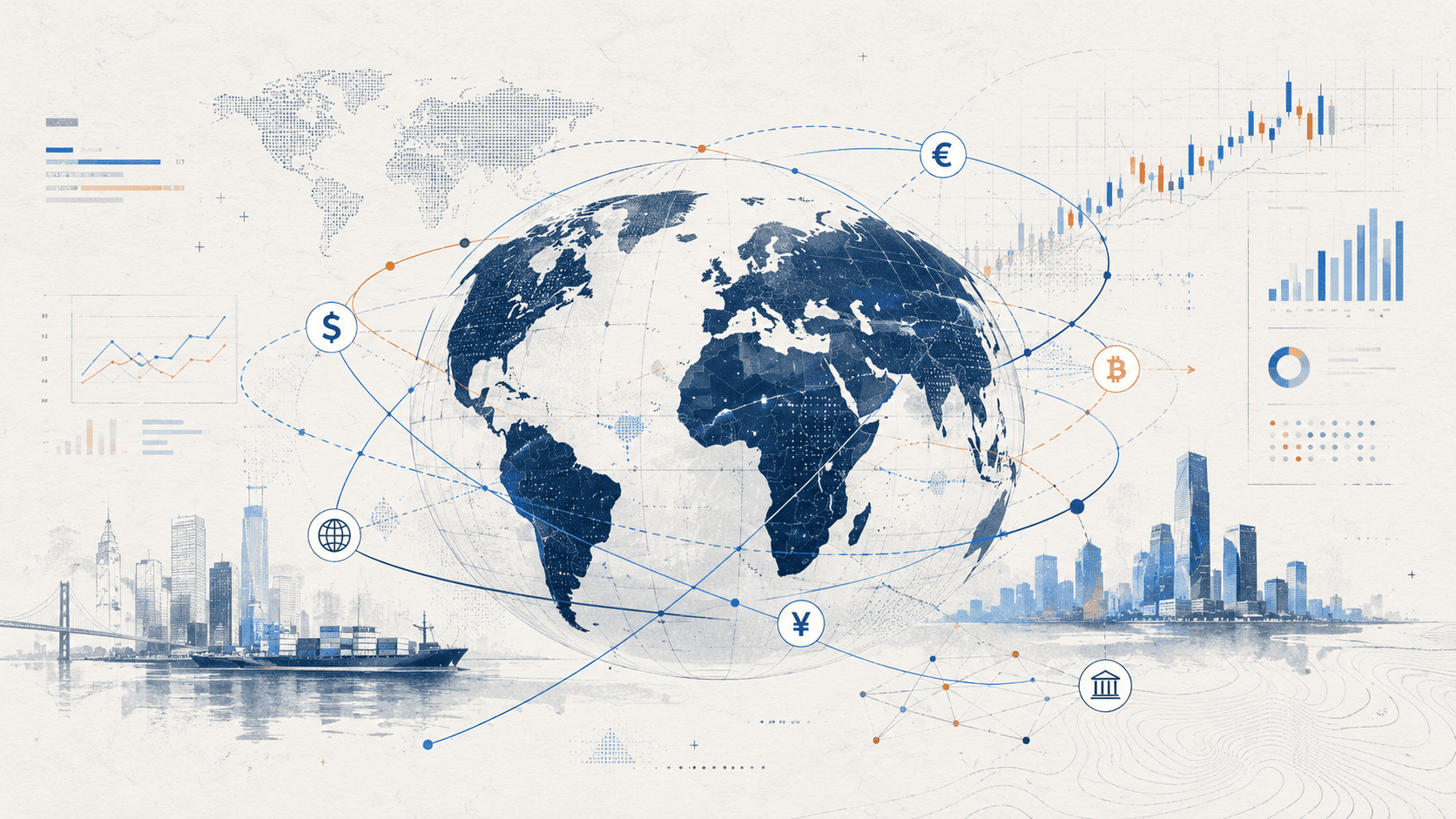
The global interest-rate cycle has stopped moving in one direction.
During the inflation surge that followed the pandemic and energy shocks of the early 2020s, the world’s largest central banks broadly followed the same path. Rates rose rapidly, financial conditions tightened and policymakers repeatedly warned that restoring price stability would take time.
In 2026, that synchronized cycle has broken apart.
The Federal Reserve is holding rates while confronting renewed US inflation. The European Central Bank has returned to monetary tightening. The Bank of England remains on hold despite internal pressure for higher rates. The Bank of Japan is continuing a historic normalization process after decades of exceptionally loose policy.
These decisions reflect more than national differences. They reveal how the global economy is being divided by energy exposure, tariffs, wage dynamics, exchange rates, public debt and investment connected with artificial intelligence.
The world no longer has one interest-rate cycle. It has several overlapping cycles responding to different versions of inflation.
Global disinflation has stalled
The International Monetary Fund’s July 2026 World Economic Outlook Update shows why central banks are becoming more cautious.
The IMF expects the world economy to grow by 3.0% in 2026 before accelerating to 3.4% in 2027. Global activity has remained more resilient than many economists expected, but progress against inflation has weakened.
Global headline inflation is projected at 4.7% in 2026. The IMF described the disinflation trend that had been in place since early 2024 as having stalled.
The main problem is that inflation is no longer being driven by only one factor.
- Energy prices have been affected by conflict in the Middle East.
- Trade restrictions and tariffs are raising the cost of imported goods.
- AI-related investment is supporting demand in technology-producing economies.
- Food and transport costs remain vulnerable to supply disruptions.
- Service inflation and wage growth are falling at different speeds across countries.
- Currency depreciation is increasing imported inflation in some economies.
This makes monetary policy more difficult. A central bank can reduce domestic demand, but it cannot directly produce oil, reopen a shipping route or remove a foreign tariff.
Policymakers must instead decide whether an external price shock will disappear on its own or spread into wages, services and inflation expectations.
The central bank divide in 2026
The latest decisions show four different approaches among major advanced economies.
| Central bank | Latest policy position | Main inflation concern | Economic constraint |
|---|---|---|---|
| Federal Reserve | Holding the federal funds target at 3.50%–3.75% | Tariffs, energy prices and renewed goods inflation | Stable labour market and resilient investment |
| European Central Bank | Raised key rates by 25 basis points in June | Energy shock spreading into broader inflation | Weak growth and uneven conditions across the euro area |
| Bank of England | Holding Bank Rate at 3.75% | Energy costs and possible second-round wage effects | Soft domestic demand and a loosening labour market |
| Bank of Japan | Guiding the overnight rate at around 1.0% | Persistent domestic inflation after years of low prices | Managing bond markets and a highly indebted economy |
The contrast is important because interest-rate differences affect exchange rates, international capital flows, government borrowing costs and the financial position of companies operating across several markets.
The Federal Reserve is facing renewed US inflation
The Federal Reserve has maintained its federal funds target range at 3.50% to 3.75% since the beginning of 2026.
That decision reflects an economy that remains strong enough to tolerate restrictive monetary policy. Employment has been broadly stable, unemployment has changed little and business investment has continued to expand.
Inflation, however, has moved in the wrong direction.
The Federal Reserve’s July Monetary Policy Report stated that the personal consumption expenditures price index increased by 4.1% over the 12 months ending in May 2026. A year earlier, the annual rate had been 2.5%.
The increase reflects two major external pressures.
Tariffs are affecting consumer goods
Higher US import tariffs introduced during 2025 pushed up the domestic price of selected consumer products. Importers and retailers initially absorbed part of the increase, but a growing share has been passed to households.
This creates a difficult policy problem. Tariffs can raise prices while simultaneously weakening trade and reducing economic efficiency.
Raising interest rates cannot reverse a tariff. It can only prevent the initial price increase from spreading into wider inflation through stronger wages, higher margins and rising expectations.
Energy has produced a second shock
Energy prices rose sharply after the escalation of conflict in the Middle East. Fuel, transport and production costs increased, adding another layer of inflation before the effects of tariffs had fully disappeared.
The Federal Reserve therefore faces an economy with solid activity but inflation well above its 2% objective.
A premature rate cut could support spending and investment while price pressures remain elevated. A new rate increase could weaken housing, consumer credit and interest-sensitive businesses without directly resolving the external supply shock.
For now, the Fed is choosing patience.
The ECB has returned to tightening
The European Central Bank took a different step in June 2026, raising its three key interest rates by 25 basis points.
The decision followed a sharp reassessment of the euro-area inflation outlook after the Middle East energy shock.
The ECB’s June projections expect headline inflation to average 3.0% in 2026, 2.3% in 2027 and 2.0% in 2028. Inflation excluding energy and food is expected to average 2.5% in both 2026 and 2027.
Europe is especially vulnerable to energy shocks because many member states depend heavily on imported fuel. Higher energy costs can move quickly into transport, electricity, food production, manufacturing and household bills.
The ECB is attempting to prevent that external shock from becoming a persistent domestic inflation process.
The euro area has a harder growth trade-off
Europe’s problem is that economic growth is weaker and less evenly distributed than in the United States.
Higher rates increase borrowing costs for businesses, homeowners and governments. They can also deepen differences between stronger northern economies and more indebted member states.
The ECB must set one policy rate for countries with different fiscal positions, housing markets, banking systems and levels of energy dependence.
The ECB is tightening not because the euro-area economy is overheating, but because an external energy shock could become embedded in domestic prices.
This is one of the clearest examples of why the 2026 rate cycle is no longer synchronized. The United States has stronger demand and tariff inflation. Europe has weaker growth but greater exposure to imported energy.
The Bank of England is divided
The Bank of England maintained Bank Rate at 3.75% at its June meeting, but the decision revealed significant disagreement inside the Monetary Policy Committee.
Seven members voted to keep the rate unchanged, while two preferred an immediate increase to 4%.
UK consumer price inflation was 2.8% in May 2026, below earlier forecasts but still above the Bank’s 2% target. The Bank expects inflation to increase later in the year as higher energy costs continue to reach households and businesses.
The policy debate is shaped by two opposing forces.
The argument for holding rates
- The labour market is gradually weakening.
- Underlying disinflation was progressing before the energy shock.
- Higher borrowing costs are already reducing demand.
- Recent energy prices have fallen from their initial peak.
- Rapid tightening could cause unnecessary damage to output and employment.
The argument for raising rates
- Energy prices remain above their pre-conflict level.
- Businesses may pass higher costs to consumers.
- Workers may seek larger wage increases to recover purchasing power.
- Inflation expectations could rise if the shock lasts longer.
- A small early increase might reduce the need for stronger action later.
The UK therefore sits between the US and euro-area positions. Inflation is not as high as in the United States, but the economy is more exposed to energy costs and weaker domestic growth.
Japan is moving in the opposite historical direction
Japan’s monetary position is different from that of other advanced economies.
For decades, the Bank of Japan tried to raise inflation and prevent deflation. Interest rates remained close to or below zero, while the central bank purchased large quantities of government bonds.
By June 2026, the Bank was guiding the uncollateralized overnight call rate at around 1.0%. This remains low compared with rates in the United States or United Kingdom, but it represents a major shift for Japan.
The Bank is also adjusting its government bond purchases as it attempts to restore a larger role for market pricing in the Japanese bond market.
Japan must normalize carefully because public debt is extremely high and many financial institutions have adapted to decades of low interest rates.
Faster tightening could increase government financing costs, pressure bond portfolios and strengthen the yen sharply. Moving too slowly could allow inflation to become more persistent and weaken household purchasing power.
Japan’s policy cycle is therefore moving upward from a much lower starting point while several other central banks are debating when tightening can eventually end.
Why the same energy shock produces different decisions
An increase in oil or gas prices affects every economy differently.
| Economic condition | Likely inflation effect | Possible central bank response |
|---|---|---|
| Strong demand and tight labour market | Higher risk that energy inflation spreads into wages and services | Hold rates high or tighten further |
| Weak demand and rising unemployment | Lower risk of persistent second-round inflation | Wait before tightening |
| Heavy dependence on imported energy | Large increase in production and household costs | Defend inflation expectations |
| Energy-exporting economy | Higher income may offset part of the price shock | Focus on domestic demand effects |
| Weak domestic currency | Imported fuel becomes even more expensive | Maintain higher rates to limit depreciation |
The appropriate policy response therefore depends on what economists call the initial conditions of the economy.
A supply shock that produces temporary inflation in one country may produce a wage-price cycle in another.
Exchange rates are becoming part of the policy problem
Interest-rate divergence can cause large movements in currencies.
When one central bank raises rates while another holds or cuts, investors may move capital toward the market offering higher expected returns. The receiving currency can strengthen, while the other currency weakens.
A weaker currency can help exporters, but it also makes imported energy, food and industrial components more expensive.
This creates an additional challenge for central banks in energy-importing economies. They may need to keep interest rates high partly to prevent currency depreciation from adding to inflation.
The result can become self-reinforcing:
- A central bank maintains lower rates than its international counterparts.
- Capital moves toward higher-yielding markets.
- The domestic currency weakens.
- Imported goods and fuel become more expensive.
- Inflation rises, limiting the central bank’s ability to cut rates.
This mechanism is especially important for emerging markets with large foreign-currency debts or strong dependence on imported energy.
Higher rates are colliding with record public debt
The Bank for International Settlements has identified the interaction between high public debt, monetary policy and financial markets as one of the main risks facing the global economy in 2026.
Governments issued large amounts of debt during the pandemic, energy crises and subsequent periods of fiscal support. As older low-interest bonds mature, many governments must refinance at higher rates.
This increases interest expenditure and reduces the budget available for infrastructure, healthcare, defence, climate investment and social programs.
It can also complicate central bank decisions.
Higher rates may be necessary to control inflation, but they can simultaneously weaken sovereign bond markets and expose financial institutions holding large amounts of government debt.
Central banks may then be forced to distinguish between two very different actions:
- Maintaining tight monetary policy to control inflation.
- Providing temporary liquidity to prevent disorderly financial-market dysfunction.
These actions can appear contradictory even when they serve different purposes.
AI investment is keeping parts of the economy stronger
The 2026 global outlook is not being shaped only by war and energy.
Investment in artificial intelligence, data centres, semiconductors, electricity generation and digital infrastructure has supported growth in economies connected to the technology supply chain.
This investment can increase productivity over time, but in the short term it also creates demand for construction, skilled workers, electrical equipment, chips and energy.
Central banks must determine whether the AI investment cycle is expanding the economy’s productive capacity or simply adding demand faster than supply can respond.
The answer may differ by country.
- Semiconductor exporters may experience stronger industrial production.
- Energy producers may benefit from rising electricity demand.
- Countries without a major technology sector may receive fewer growth benefits.
- Economies importing advanced equipment may face larger trade deficits.
- Cities with concentrated data-centre construction may experience local labour and energy shortages.
The technology cycle is therefore another reason monetary policy is becoming less synchronized.
What rate divergence means for households and businesses
Mortgage and housing markets
Households with variable-rate mortgages or loans that must be refinanced will continue to face pressure where central banks hold rates high.
Housing markets may remain divided between countries with long-term fixed mortgages and those where borrowing costs reset more frequently.
Corporate financing
Companies with large amounts of floating-rate or short-term debt will face higher financing costs. Businesses with strong cash positions may gain an advantage over competitors dependent on continual borrowing.
Currency exposure
International businesses may face greater volatility when revenue is earned in one currency but debt, suppliers or wages are denominated in another.
Emerging-market debt
Countries and companies that borrowed in dollars may face rising repayment costs when US rates remain high and their domestic currencies weaken.
Savings and investment
Higher deposit and bond yields can benefit savers, but they also reduce the relative attraction of riskier assets and increase financing costs for new projects.
What to watch next
Whether energy inflation spreads into services
Central banks will examine whether the energy shock remains concentrated in fuel and utilities or begins to affect wages, rents, transport services and business margins.
US tariff pass-through
The Federal Reserve will need to judge how much of the tariff increase has already reached consumer prices and whether businesses will continue passing costs to households.
The next ECB decisions
The ECB’s June increase may be a limited response to an external shock or the beginning of a longer tightening phase. Future decisions will depend heavily on energy markets and inflation expectations.
The divided Bank of England vote
A larger group supporting higher rates would indicate that concerns about second-round inflation are becoming more important than signs of weak demand.
Japan’s bond-market normalization
The Bank of Japan must continue reducing its extraordinary role in government bond markets without producing excessive volatility or an abrupt rise in public financing costs.
Government refinancing pressure
Higher rates will become more visible in public budgets as low-cost debt matures and governments issue new bonds at higher yields.
The global economy has entered an asymmetric rate cycle
The central banking environment of 2026 is fundamentally different from the synchronized tightening phase that followed the earlier inflation surge.
Inflation remains a global problem, but its causes and intensity are increasingly local.
The United States is dealing with tariffs, strong demand and renewed energy inflation. The euro area is confronting imported energy pressure despite fragile growth. The United Kingdom is balancing weaker activity against the risk of persistent wage and price effects. Japan is still moving away from a monetary system built around near-zero rates.
These differences mean that exchange rates, capital flows and borrowing costs may remain volatile even when the global growth outlook appears relatively stable.
The next stage of monetary policy will not be defined by a single global decision to raise or lower rates.
The defining question is no longer when the world will cut rates. It is which economies can cut, which must hold and which may still need to tighten.
For businesses, investors and governments, understanding those differences is becoming as important as following the direction of any individual central bank.
Sources and further reading
- International Monetary Fund: World Economic Outlook Update, July 2026
- Federal Reserve: Monetary Policy Report, July 2026
- European Central Bank: Monetary Policy Decisions, June 2026
- Bank of England: June 2026 Monetary Policy Summary and Minutes
- Bank of Japan: Current Monetary Policy and Market Operations
- Bank for International Settlements: Annual Economic Report 2026
This article is provided for general information and economic analysis. It does not constitute financial, investment, legal or tax advice.
Author

Selina Davies ist Technologieautorin und Blockchain-Enthusiastin mit einer Leidenschaft für die Vereinfachung komplexer Themen. Mit ihrer langjährigen Erfahrung in den Bereichen Fintech und dezentrale Systeme konzentriert sie sich darauf, ihre Leser durch klare, präzise und ansprechende Inhalte über die Zukunft der digitalen Innovation aufzuklären.