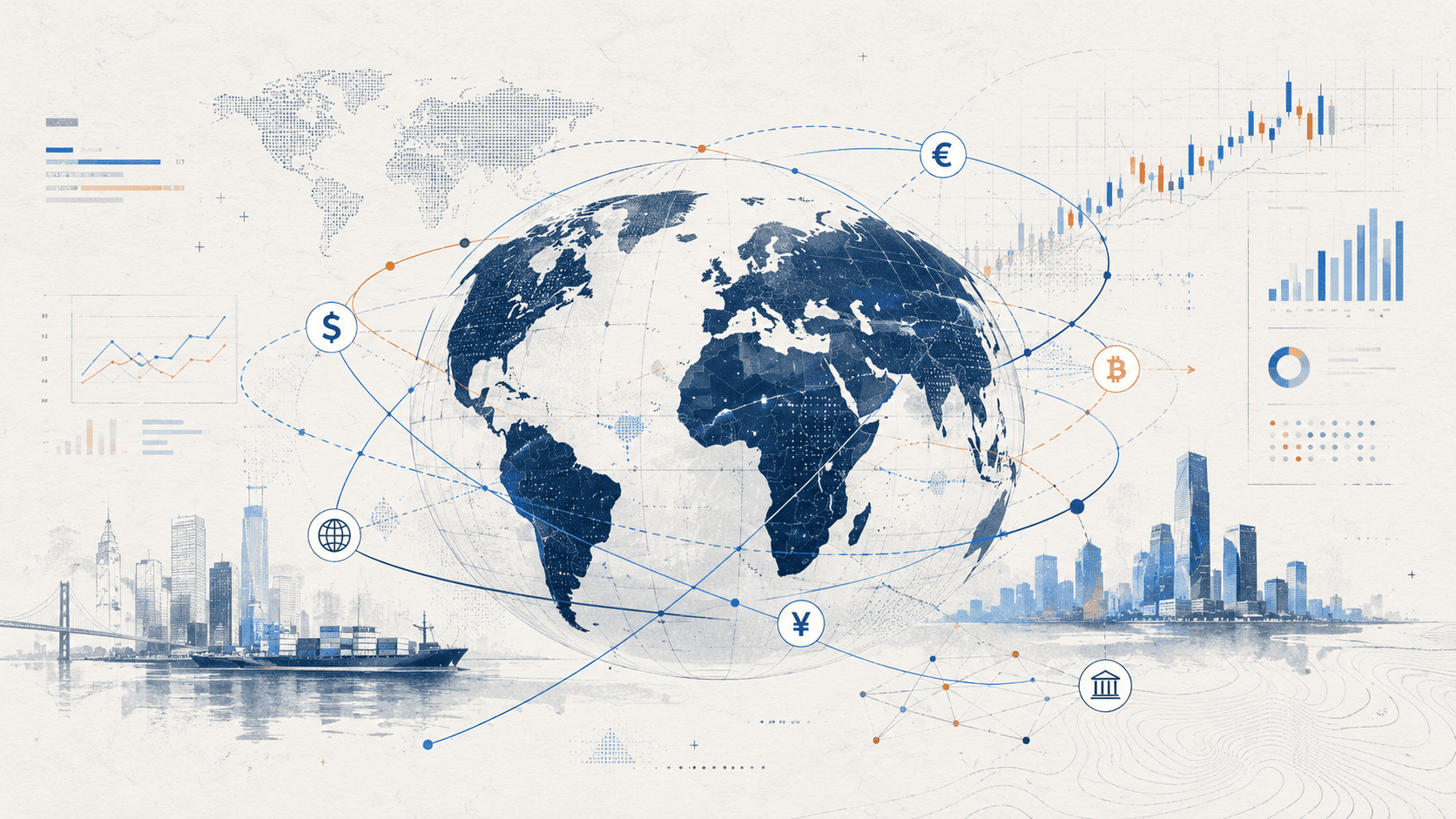
In 2026, those efforts are becoming more practical. New payment technologies, regional settlement networks and stronger political cooperation are giving countries more options than they had a decade ago.
Yet the latest reserve data show that the dollar is not being rapidly displaced. It remains the dominant currency in official reserves, international banking, debt markets and cross-border finance.
The emerging picture is therefore more complicated than a simple decline of the dollar. The world economy appears to be moving toward gradual monetary diversification while remaining deeply dependent on dollar-based infrastructure.
De-dollarization is becoming more credible as a strategy, but it has not yet become a replacement for the dollar-centered financial system.
What the latest reserve data show
The International Monetary Fund’s Currency Composition of Official Foreign Exchange Reserves data provide one of the clearest measures of the dollar’s international position.
According to the IMF’s July 2026 data release, total reported foreign-exchange reserves stood at approximately $13.10 trillion in the first quarter of 2026.
The US dollar represented 57.13% of those reserves, increasing from 56.42% in the previous quarter. The euro accounted for 20.03%, while the Chinese renminbi represented only 1.99%.
| Reserve currency | Share in 2026 Q1 | Position |
|---|---|---|
| US dollar | 57.13% | Dominant global reserve currency |
| Euro | 20.03% | Second-largest reserve currency |
| Japanese yen | 5.44% | Important secondary reserve asset |
| Chinese renminbi | 1.99% | Limited official reserve role |
| Other currencies | Remaining share | Gradually diversifying category |
Quarterly movements do not always represent deliberate policy decisions by central banks. Exchange-rate changes can increase or reduce the dollar value of reserves even when reserve managers have not bought or sold any assets.
The IMF estimated that currency valuation effects accounted for approximately half of the dollar’s increase during the first quarter of 2026.
The broader conclusion remains clear: reserve managers are diversifying slowly, but there is no evidence of a sudden global exit from the dollar.
Why the dollar remains difficult to replace
A reserve currency is not dominant only because governments choose to hold it. Its position depends on a much larger network of financial markets, payment systems, debt contracts, trade relationships and trusted institutions.
The dollar benefits from several advantages that reinforce one another.
Deep and liquid capital markets
Central banks and international investors need assets that can be purchased or sold in very large quantities without severely disrupting prices.
The US Treasury market provides a scale and level of liquidity that few alternatives can match. This makes dollar-denominated government debt useful as a reserve asset, collateral instrument and source of emergency liquidity.
A large international banking network
Banks outside the United States borrow, lend and manage liquidity in dollars. Companies issue dollar-denominated debt, while investors use dollar markets to finance international activity.
Bank for International Settlements data show that foreign-currency lending in dollars and euros continued to expand during 2025. Global cross-border bank claims reached approximately $46 trillion by the end of that year, following the fastest annual expansion since 2008.
This creates a powerful network effect. Companies use dollars because banks provide dollar financing, and banks maintain dollar operations because companies and investors continue to demand them.
Trade invoicing
A significant share of international trade is priced in dollars even when the United States is not directly involved in the transaction.
Commodities such as oil and many industrial inputs are commonly priced in dollars. Businesses therefore maintain dollar liquidity to manage supplier payments, hedging and working capital.
Financial infrastructure
The dollar is embedded in correspondent banking networks, foreign-exchange markets, derivatives, securities settlement systems and central bank liquidity arrangements.
Replacing a currency therefore requires more than announcing a new unit of account. It requires building a complete financial ecosystem around it.
BRICS alternatives are becoming more realistic
The political pressure to reduce dollar dependence is strongest among emerging economies seeking greater control over trade and financial flows.
In July 2026, economist Jim O’Neill, who originally created the BRIC acronym, said technological advances had made alternatives to the dollar more realistic than they appeared only 18 months earlier.
His comments did not suggest that BRICS countries are close to launching a unified reserve currency. Instead, they reflected growing confidence that payment technology can help countries settle more transactions without relying on traditional dollar-based channels.
BRICS members and partner economies have discussed several possible approaches:
- Connecting national instant-payment systems.
- Settling bilateral trade in domestic currencies.
- Developing the proposed BRICS Pay infrastructure.
- Expanding China’s Cross-Border Interbank Payment System.
- Using central bank digital currencies for international settlement.
- Increasing financing through the New Development Bank.
India’s Unified Payments Interface, Brazil’s PIX and China’s payment infrastructure demonstrate that major emerging economies can develop efficient domestic systems.
The next challenge is interoperability: enabling national systems to communicate, convert currencies and settle international transactions under compatible legal and compliance standards.
BRICS still lacks monetary unity
The BRICS economies do not form a monetary union. They have different inflation rates, capital controls, political priorities, exchange-rate systems and levels of financial-market development.
China is a major exporter and creditor. India maintains a different strategic and economic position. Brazil depends heavily on commodity exports, while several newer BRICS members face their own currency and financial-stability challenges.
These differences make it difficult to create a shared currency or unified monetary authority.
A more realistic outcome is a network of connected payment systems that allows countries to use several currencies rather than one new BRICS currency replacing the dollar.
The euro has a different opportunity
The euro is already the world’s second most important international currency. Unlike a proposed BRICS currency, it has a central bank, a shared monetary policy and a large existing financial market.
The European Central Bank reported in June 2026 that the euro’s share across a broad group of international currency indicators had increased moderately to around 20%.
International issuance of euro-denominated debt increased by approximately 30% in 2025 and reached its highest level since the creation of the single currency. The euro also became the leading currency in international green and sustainable bond issuance.
These developments suggest that the euro could attract more international borrowers and investors, particularly when confidence in US policy becomes less predictable.
However, Europe still faces structural limitations.
- Euro-area government debt is divided among many national issuers.
- European capital markets remain less integrated than US markets.
- Banking and financial regulation is not completely unified.
- There is no single euro-area safe asset comparable in scale to US Treasuries.
- Economic growth remains uneven across member states.
The euro therefore has the institutional foundation to gain international influence, but that expansion depends on deeper European financial integration.
Why the renminbi remains a limited reserve currency
China is one of the world’s largest economies and trading nations, yet the renminbi accounted for less than 2% of reported global foreign-exchange reserves in the first quarter of 2026.
This gap illustrates the difference between economic size and international currency trust.
The renminbi is used increasingly in trade involving China, but its broader reserve role is constrained by capital controls, limited currency convertibility and the structure of Chinese financial markets.
Reserve managers need confidence that they can move funds freely, obtain reliable pricing and access liquid assets during a crisis.
China can increase the renminbi’s role through trade agreements and payment infrastructure. However, a major increase in international reserve use would likely require greater openness, transparency and financial-market accessibility.
Gold is returning as a strategic reserve asset
Currency diversification is not limited to the euro or renminbi. Central banks have also increased their interest in gold.
The IMF noted that gold surpassed US Treasuries as a share of official reserves in 2025. However, much of this shift was caused by the rising market price of gold rather than a comparable collapse in central bank demand for dollar assets.
Gold appeals to reserve managers because it is not issued by another government and does not depend on a foreign banking institution’s promise to pay.
It can therefore serve as a form of protection against geopolitical sanctions, currency depreciation and loss of confidence in sovereign debt.
Gold also has important limitations. It does not provide the same payment infrastructure, interest income or day-to-day liquidity as a major reserve currency.
Its rise should therefore be understood as part of reserve diversification, not as a complete substitute for dollars, euros or other currencies.
Digital money could change de-dollarization
Payment technology may have a greater near-term impact on dollar dependence than the creation of a new reserve currency.
Countries do not necessarily need to replace the dollar in official reserves before reducing its role in selected trade and payment corridors.
They can instead connect domestic payment systems, develop direct currency-conversion arrangements or use central bank digital currencies for settlement.
Stablecoins create a contradictory effect
Stablecoins can reduce reliance on traditional US banks and correspondent banking channels. However, most stablecoins are denominated in dollars.
The Bank for International Settlements estimated in 2026 that approximately 98% of stablecoin value was dollar-denominated.
This means blockchain technology may weaken the position of some conventional payment intermediaries while strengthening the dollar’s role as a digital unit of account.
A payment can move outside the traditional US banking system while remaining completely dependent on the US dollar.
For emerging economies, this can increase access to international money but also accelerate digital dollarization and weaken domestic monetary sovereignty.
De-dollarization is not one process
The term de-dollarization is often used to describe several different economic changes. These processes should not be treated as identical.
| Type of de-dollarization | What it means | Current progress |
|---|---|---|
| Reserve diversification | Central banks hold fewer dollars and more gold or other currencies | Gradual |
| Trade settlement | Countries pay for imports and exports in national currencies | Growing in selected corridors |
| Payment infrastructure | Transactions move through non-US systems | Developing rapidly |
| Debt denomination | Borrowers issue more bonds outside the dollar market | Mixed |
| Private savings | Households and companies prefer non-dollar assets | Highly dependent on the country |
A country may reduce dollar settlement in bilateral trade while continuing to hold dollar reserves and borrow through dollar markets.
Another country may buy more gold but still depend on dollar-priced commodities and dollar funding for its banks.
This is why individual announcements rarely prove that the global monetary system has fundamentally changed.
International debt markets tell a more complex story
Research published by the Bank for International Settlements in January 2026 found no simple long-term movement toward either dollarization or de-dollarization in international bond markets.
Instead, the dollar’s share has moved in waves since the 1960s. The most recent major dollarization wave followed the global financial crisis and brought the dollar’s share close to its level at the launch of the euro in 2000.
This historical pattern matters because international currency systems respond to crises, interest-rate cycles and financial-market development.
A period of dollar weakness does not automatically create a permanent structural decline. Equally, current dominance does not guarantee that the dollar’s position will remain unchanged indefinitely.
What could genuinely weaken the dollar?
The dollar is unlikely to lose its central role because of one summit, one bilateral trade agreement or one digital payment platform.
A lasting decline would probably require several structural changes to happen together.
- Lower global confidence in US economic governance.
- Persistent concerns about federal debt and fiscal sustainability.
- Reduced confidence in the independence and credibility of US institutions.
- Greater political use of financial sanctions.
- Development of large and liquid alternative safe-asset markets.
- More open and interoperable international payment networks.
- Greater willingness among exporters to invoice trade outside the dollar.
The most important risk to the dollar may therefore come from the United States itself.
Reserve-currency status depends partly on trust that financial rules will remain predictable and that foreign investors will continue to have access to deep, open markets.
Political instability, unpredictable trade policy or concerns about public debt could gradually encourage governments and investors to build alternatives.
What to watch next
The dollar’s share after valuation adjustments
Headline reserve shares can move because currencies rise or fall against the dollar. The more meaningful indicator is whether central banks are actively changing the composition of their portfolios.
Growth in non-dollar trade settlement
Announcements matter less than actual transaction volumes. Future data should show whether national-currency trade settlement is expanding beyond politically strategic agreements.
BRICS payment-system interoperability
The practical test is whether domestic systems such as PIX, UPI and CIPS can be connected in a way that supports reliable international settlement.
European capital-market integration
The euro’s international role could grow significantly if Europe creates deeper capital markets and a larger supply of common safe assets.
China’s approach to capital controls
The renminbi is unlikely to become a leading reserve currency while global investors face substantial restrictions on moving money into and out of China.
The role of digital dollars
Dollar stablecoins may become one of the most important forces shaping the international monetary system. They could weaken traditional dollar payment channels while expanding global access to dollar-denominated money.
The world is diversifying, not abandoning the dollar
The latest evidence does not support the claim that the dollar is about to disappear as the foundation of international finance.
Its share of official reserves remains above 57%. Dollar funding continues to support global banks and borrowers. US financial markets remain deeper and more liquid than the available alternatives.
At the same time, the monetary system is no longer completely static.
BRICS countries are exploring connected payment systems. Europe is seeking a stronger international role for the euro. Central banks are increasing exposure to gold and smaller reserve currencies. Digital money is creating new ways to move value across borders.
The result may not be a post-dollar world. It may be a more fragmented and multi-layered system in which the dollar remains dominant but is no longer the only credible infrastructure for international settlement.
The defining monetary shift of the 2020s may be the transition from dollar exclusivity to dollar-centered competition.
That change will be gradual. It will emerge through payment systems, trade corridors, reserve-management decisions and financial technology rather than through a single announcement of a new global currency.
Sources and further reading
- International Monetary Fund: Currency Composition of Official Foreign Exchange Reserves, 2026 Q1
- Reuters: BRICS alternatives to the dollar are becoming more realistic
- European Central Bank: The International Role of the Euro, June 2026
- Bank for International Settlements: Dollarisation Waves
- Bank for International Settlements: International Banking Statistics and Global Liquidity Indicators
- Bank for International Settlements: Stablecoins and the International Monetary System
This article is provided for general information and economic analysis. It does not constitute financial, investment, legal or tax advice.
Author

Selina Davies ist Technologieautorin und Blockchain-Enthusiastin mit einer Leidenschaft für die Vereinfachung komplexer Themen. Mit ihrer langjährigen Erfahrung in den Bereichen Fintech und dezentrale Systeme konzentriert sie sich darauf, ihre Leser durch klare, präzise und ansprechende Inhalte über die Zukunft der digitalen Innovation aufzuklären.