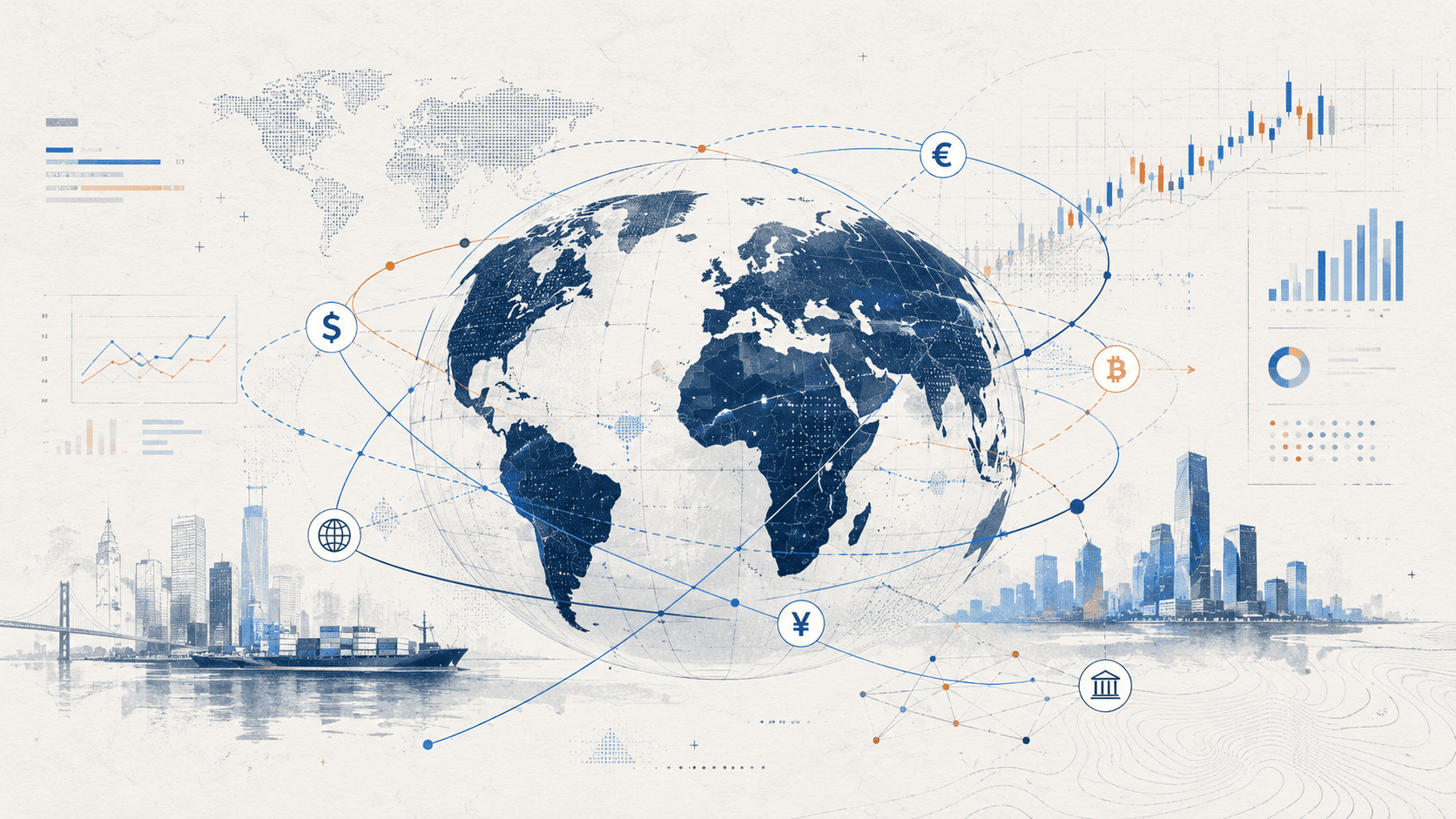
A ship changing course in the Gulf can now influence fuel bills in Europe, fertilizer costs in Africa, factory schedules in Asia and food inflation across emerging markets.
The global economy has become efficient by concentrating trade in a small number of maritime corridors. In 2026, that efficiency is being repriced as geopolitical risk.
Four numbers define the chokepoint economy.
Approximate share of global seaborne crude oil trade passing through the Strait of Hormuz.
World Bank projection for global energy prices in 2026.
WTO forecast for world merchandise trade growth in 2026 before a prolonged energy shock.
Possible average Brent price in a severe and prolonged disruption scenario.
Global trade is usually discussed in terms of tariffs, factories and consumer demand. The events of 2026 are showing that geography can be just as important. A small number of narrow waterways still determine how quickly energy, food, industrial components and consumer goods move between continents.
The Strait of Hormuz connects Gulf energy exporters with international markets. The Bab al-Mandeb links the Indian Ocean with the Red Sea. The Suez Canal provides the shortest major maritime route between Asia and Europe. When one corridor becomes unsafe, shipping companies can often reroute. But rerouting requires more fuel, more vessels, more insurance and more time.
That extra distance does not remain a shipping-industry problem. It eventually appears in energy prices, freight contracts, factory inventories, food production and central bank inflation forecasts.
A route reopens, then the risk changes again.
WTO cuts the trade outlook
The WTO forecasts merchandise trade growth of 1.9% for 2026 and warns that persistent energy and transport disruption could reduce it further.
World Bank identifies an historic oil shock
The Bank estimates an initial global oil-supply reduction of approximately 10 million barrels per day and raises its energy-price projections.
Maersk resumes another Red Sea service
The WAF6 service returns to the trans-Suez corridor as the shipping industry cautiously tests whether normal routes can be restored.
Hormuz tanker traffic falls sharply
Escalating US-Iran tensions push tanker activity to a two-month low. Some vessels reduce tracking visibility or avoid the passage.
Infrastructure attacks widen the risk
New attacks and threats against maritime routes revive concerns that disruption could spread from Hormuz toward the Bab al-Mandeb and Red Sea corridor.
The crisis is no longer about one strait.
The traditional view of maritime risk treats each chokepoint as a separate problem. Hormuz affects energy. Suez affects container trade. Panama affects routes between the Atlantic and Pacific.
In reality, these routes form one network. When one corridor closes, ships move into another. That alternative route then becomes more crowded, consumes additional fuel and places pressure on ports that were not designed to absorb the diverted traffic.
The energy artery
Hormuz carries oil and liquefied natural gas from major Gulf producers. A prolonged slowdown affects crude benchmarks, tanker availability, refinery margins and government revenues.
The southern gate
This narrow passage connects the Gulf of Aden with the Red Sea. Security risks here can prevent ships from reaching Suez even when the canal itself remains operational.
The time-saving corridor
Suez shortens routes between Asia and Europe. Avoiding it can add thousands of kilometres to a voyage and reduce the number of trips each vessel completes annually.
The expensive fallback
The route around southern Africa keeps trade moving, but requires more fuel, labour, insurance, vessel capacity and inventory planning.
Rerouting prevents a complete interruption of trade. It does not make the disruption economically neutral.
How a maritime shock reaches the consumer.
Security risk increases
Shipowners, crews and insurers reassess whether the route can be used safely and whether naval protection is sufficient.
Insurance and freight costs rise
War-risk premiums increase, while longer routes require more fuel and keep ships occupied for additional days.
Delivery schedules become unreliable
Manufacturers and retailers increase inventories because just-in-time supply chains become less predictable.
Production costs spread across sectors
Energy, fertilizer, chemicals, plastics, transport and food production become more expensive.
Inflation returns to policy decisions
Central banks delay rate cuts or consider further tightening even when domestic economic growth is weak.
Government budgets absorb the shock
Fuel subsidies, food support, defence spending and higher public borrowing costs compete for limited fiscal resources.
The 2026 commodity reset.
The World Bank’s April outlook marked a major reversal from expectations published only months earlier. Before the Middle East escalation, many analysts expected weak global demand and excess oil supply to push commodity prices lower.
The new forecast projects a 16% increase in overall commodity prices during 2026. Energy prices are expected to rise by 24%, while fertilizer prices may rise by 31%.
| Indicator | 2026 baseline | Stress implication | Economic transmission |
|---|---|---|---|
| Overall commodity prices | Increase of 16% | Broad cost pressure | Manufacturing, food and household inflation |
| Energy prices | Increase of 24% | Highest level since the 2022 shock | Fuel, electricity, transport and industrial costs |
| Fertilizer prices | Increase of 31% | Lower affordability for farmers | Future crop yields and food prices |
| Brent crude | Average of approximately $86 | Up to $115 in severe disruption | Inflation, trade balances and fiscal pressure |
| Developing-economy inflation | Higher than earlier forecasts | Potentially 5.8% in the severe scenario | Higher rates and weaker household purchasing power |
Global trade disruption
The risk is elevated but not yet equivalent to a complete closure of all major routes. Shipping can still adapt, inventories exist and some energy exports can use pipelines or alternative ports. The danger lies in simultaneous or repeated disruption across several corridors.
Who pays first?
Import-dependent economies
Countries importing fuel, fertilizer and food face weaker currencies, wider trade deficits and greater pressure on public subsidies.
Small manufacturers
Companies with limited inventories and weak bargaining power struggle to absorb freight delays and higher input prices.
Low-income households
Food, transport and energy represent a larger share of their spending, making commodity inflation especially damaging.
Highly indebted governments
Higher inflation can delay rate cuts, raise refinancing costs and reduce the fiscal space available for economic support.
Three scenarios for the second half of 2026.
Routes reopen gradually
Security conditions improve, Maersk and other carriers restore more Suez services, Hormuz traffic normalizes and energy prices retreat from crisis levels. Trade growth remains weak but positive.
Trade moves, but never normally
Intermittent attacks, seizures and warnings cause carriers to alternate between direct and longer routes. Freight contracts stay expensive and companies maintain larger inventories.
Hormuz and Red Sea risks combine
Simultaneous pressure on Hormuz and Bab al-Mandeb produces a severe energy and shipping shock. Oil, LNG and container flows become harder to reroute, increasing recession and inflation risks.
Myth versus reality.
Most cargo can be rerouted. The economic damage comes from longer distances, delayed vessel cycles, higher costs and congestion elsewhere.
Vessels remain out of position, port schedules become misaligned and containers accumulate in locations where they are not needed.
Exporters can also lose revenue, while countries far from the affected route face higher freight, fertilizer, food and financing costs.
Air travel, tourism, insurance, logistics and transport services respond directly to security conditions and energy prices.
Why rebuilding resilience will be expensive.
The most obvious response is diversification. Energy exporters can build pipelines that bypass narrow waterways. Manufacturers can use more suppliers. Shipping companies can maintain alternative schedules. Governments can increase strategic reserves.
Every form of resilience, however, requires duplication. A second supplier may be more expensive. A strategic reserve ties up capital. A pipeline may remain partly unused during normal conditions. A company holding more inventory loses some of the efficiency gained from just-in-time production.
The world economy is therefore entering a period in which redundancy may be valued more highly than maximum short-term efficiency.
What to watch next
- Whether major container carriers continue restoring services through the Red Sea and Suez Canal.
- Daily tanker and LNG carrier traffic through the Strait of Hormuz.
- War-risk insurance premiums for Gulf and Red Sea routes.
- Whether Houthi activity expands toward a broader Bab al-Mandeb blockade.
- Changes in Brent crude, European natural gas and fertilizer benchmarks.
- Whether WTO trade forecasts are revised below the 1.9% baseline.
- Government investment in pipelines, strategic reserves and alternative ports.
The deeper economic lesson.
Globalization did not eliminate geography. It created a system in which geography could be temporarily ignored because a small number of routes remained reliable.
That assumption is now being questioned. Companies and governments are discovering that the cheapest route is not always the most secure, and the fastest supply chain is not always the most resilient.
The long-term result may be a world economy with more inventories, more regional production, more alternative infrastructure and higher average transport costs.
The chokepoint economy does not require a complete blockade to generate inflation. Persistent uncertainty alone can force companies to behave as though disruption may return at any moment.
Short FAQ
Why is the Strait of Hormuz so important?
It connects major Gulf oil and gas exporters with the open ocean. A large share of internationally traded seaborne crude passes through the route.
Can ships completely avoid the Red Sea?
Yes. Ships can travel around the Cape of Good Hope, but the voyage is longer and generally requires more fuel, vessel capacity and time.
Why do shipping disruptions increase food prices?
Food production depends on fuel, fertilizer, machinery and transport. Higher energy and freight costs can affect both farm production and final delivery.
Do higher oil prices always create a global recession?
Not automatically. The outcome depends on the duration of the shock, available supply, household savings, government support and central bank policy.
Could alternative pipelines replace Hormuz?
Existing and planned pipelines can reduce dependence on the strait, but current alternatives cannot fully replace all the oil and gas volumes normally shipped through it.
Sources and further reading
- World Bank: Commodity Markets Outlook, April 2026
- World Trade Organization: Middle East conflict weighs on global trade outlook
- World Trade Organization: AI investment and Middle East conflict shape global trade
- Reuters: Maersk resumes another service through the Red Sea
- Reuters: Hormuz tanker traffic slows as security risks increase
- Reuters: Infrastructure attacks widen concerns over energy and shipping routes
This article is provided for general information and economic analysis. It does not constitute financial, investment, legal or political advice.
Author

Selina Davies ist Technologieautorin und Blockchain-Enthusiastin mit einer Leidenschaft für die Vereinfachung komplexer Themen. Mit ihrer langjährigen Erfahrung in den Bereichen Fintech und dezentrale Systeme konzentriert sie sich darauf, ihre Leser durch klare, präzise und ansprechende Inhalte über die Zukunft der digitalen Innovation aufzuklären.